
How to identify a bee, different bee types and beautiful bee colors you may have NEVER seen before - purple, blue and green

Bees have the following physical characteristics:
4 Most common bee types

Bumble bees
In your backyard or garden, you may find bumblebees buzzing around the flora.
They are large, hairy, you may be familiar with the black and yellow color ones. These bumblebees are most active in the spring and summer, pollinating plants and flowers and collecting nectar for honey.
There are over 250 different species of bees, with the majority of them found in the Northern Hemisphere. They are social insects with black and yellow hairs that form stripes on the bee's body. They can also be red or orange in colour, and some bees are almost completely black. Bumble bees have a fuzzy appearance and feel. Bumble bees' thick fuzzy hairs keep them warm during the winter.
They collect pollen, which they use to feed their young. The bee's tongue is long and hairy. It protrudes from a sheath and is used to drink liquids such as nectar.
The bumble bee is more common at higher latitudes and higher altitudes. However, there are a few tropical species of bumble bees. The bee has the ability to regulate its body temperature through a variety of mechanisms, including "shivering" and solar radiation. They can also keep cool by radiating heat from their bodies through their abdomen.
Bumble bee colonies are typically smaller than honey bee colonies. Mature bee nests can only hold about 50 individuals. Nests can be found beneath the ground in tunnels dug by other animals. They frequently construct a waxy protective canopy that can help insulate the colony during the winter months. A queen bumble bee from a colony will usually survive the winter and then build a new colony when she emerges from hibernation in the warmer spring months. She gathers pollen and nectar from flowers before locating a suitable location for the nest to restart the cycle.

Carpenter bees
Carpenter bees can reach a size of half an inch to an inch. They have four wings, the top two of which are longer than the bottom two. The bees are black with a yellow area directly beneath the head. Males have a yellow face, while females have a black face. There are seven species of carpenter bees, but the ones most commonly seen in the United States resemble bumblebees, except that the bee's top is bare and shiny rather than fuzzy.
Carpenter bees are not social, and they do not live in nests or with other bees. They like to burrow wherever they can find wood, which is most likely to be in houses. Carpenter bees like to drill small holes in wood and use them as a home. Females will even build a nest and lay eggs in the holes. They will also nest in other wooded areas, such as trees and firewood, but they usually have no effect on humans in those areas
When bees land on a plant, they spread pollen throughout the plant, which is very beneficial to the environment. They, like other types of bees, feed on nectar from flowers and small insects.

Honeybees
- The honey bee, which generates an abundance of honey, is the only insect known to provide food for people. Every other insect known to produce food for humans has been discovered except for the honey bee.
- It has been proven scientifically that they are extremely intelligent insects capable of distinguishing unique human faces.
- Tenth, they die after stinging another insect, unlike several of their insect cousins, which survive after stinging another insect.
- In the United States of America alone, honey bees pollinate nearly 80 percent of all fruit, vegetable, and seed crops.When flying to a food source, a worker's regular top speed would be about 15-20 mph (21-28 km/h), and about 12 mph (17 km/h) when returning with nectar, pollen, propolis, or water in his or her possession.
- It has been revealed that they have five eyes, three small ones on the top of the head and two large ones in front, which is somewhat surprising.
- The way they will communicate with one another will be through dancing and the use of pheromones, which will be completely different from the way they will communicate with one another.
- When looking for food for their hive, it has been noted that they will attempt to travel up to 3 miles away from their hive, where the other bees live, in order to obtain food.
- It has been experimentally shown that the queen can lay between 600 and 800 eggs per day, and occasionally as many as 1500 eggs per day, for the rest of her natural life. 7.
- The bees' distinctive buzz is caused by their wings beating at a rate of 11400 times per minute, according to scientific research.
Ground bees

Mining bees are members of the Andrenidae family, which encompasses thousands of species all over the world, including thousands of species in the United States. A single bee colony, mining bees dig subterranean tunnels and cells in which to nurse their young; these tunnels are often apparent as little mounds in the ground, similar to worm casts. There can be a main tunnel and five or six branches, each of which holds an egg cell. A nest can be constructed from these components. Mining bees prefer sandy soil, which is why they are so successful. As beneficial pollinators, they pose no threat to a garden and should be encouraged to visit.
And now for some Bees you may never have seen before
 Xylocopa Caerulea - blue bee

Carpenter bees are Xylocopa species from the Xylocopinae subfamily. The genus has 500 species in 31 subgenera. Most species burrow into hard plant material such as dead wood or bamboo, earning them the nickname "carpenter bees." Except for Proxylocopa species, which dig nest tunnels in suitable soil.
Non-professionals frequently confuse carpenter bees with bumblebees; the simplest rule of thumb for distinguishing them is that most carpenter bees have a shiny abdomen, but bumblebee abdomens are entirely coated with dense hair. Unlike Bumble bees, some species of carpenter bees have a white or yellow face, whilst females lack the bare corbicula found on bumblebees' rear legs; the hind leg is completely hairy in some species.
 Most carpenter bee species are solitary, although others develop modest communal nests where moms and daughters coexist. When females cohabit, they sometimes share the work. Females either divide foraging and nest-laying duties or one female undertakes all foraging and nest-laying while the other females guard.
 Euglossa dilemma - Orchid Bees
Purple Orchid bee
.jpg "metallic purple bee orchid")
Green Orchid Bee
- The majority of the species of the tribe are isolated, however some are communal or have a simple eusocial nature.

- The species described are approximately 200, divided in 5 genera: Euglossa, Eulaema, Eufriesea, Exaerete, and monotypical Aglae.
- The Exaerete and Aglae generations are kleptoparasites in orchid bee nests.
- Male orchid bees have uniquely modified legs which are used to collect and store different volatile compounds (often esters) throughout their lives, primarily from orchids in the subtribes Stanhopeinae and Catasetinae, where all species are exclusively pollinated by euglossine males.
- Neotropical orchids themselves often exhibit elaborate adaptations involving highly specific placement of pollen packets (pollinia) on the bodies of the male orchid bees; the specificity of their placement ensures that cross-pollination only occurs between orchids of the same species.
_(7870772768).jpg "metallic green bee orchid")
Metallic Blue Halictid Bee
- In the tropical Augochloropsis species, a wide range of social activity has been seen.

- These include solitary, communal, semi-social and even eusocial behaviour.
- There has been some evidence in this genre of division of labour or splitting social roles.
- It has at least been seen as a sign that individuals have different levels of reproductive responsibility inside the nest and that division of labour within the nest was strongly demonstrated.
- In Augochlorine bees, there are a huge number of behavioural variations.
.jpg "metallic blue bee")

 3 ways you can help rescue bees
 Visit my Bee Store for Bee awareness buttons, stickers, keychains and personalized gifts, accessories and decor.

 Hungry Caterpillar | Save the Bees Postcard
 Save the bees add your own quote classic round sticker
 Save the Bees Vintage Fuzzy Bumble Bee Beekeeper Trucker Hat
 BEES and Honeycomb - Save The Bees Fleece Blanket
 BEE Watching Journal - Bee Keepers and Rescuers
 Save The Bees - Quotes, Slogans Sayings Sunflowers Air Freshener
 BEE Watching Journal - Bee Keepers and Rescuers
 BEES and Honeycomb - Save The Bees Throw Pillow
 BEE Watching Journal - Bee Keepers and Rescuers
 BEES and Honeycomb - Save The Bees Mug
 Save The Bees - Quotes, Slogans Sayings Sunflowers Mug
 Save The Bees Tank Top
 BEES and LadyBugs - Art by LeahG Save The Bees Thermal Tumbler
 Save The Bees Premium Face Mask
 Vintage Bee Design T-Shirt
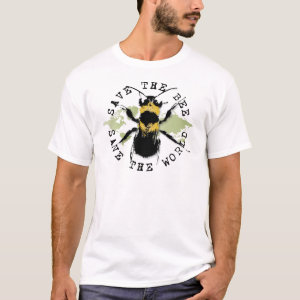 Save the Bee! Save the World! Medallion Collection T-Shirt
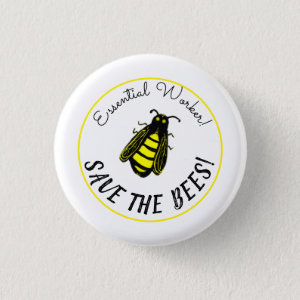 Essential Worker Cute Bee Art Save the Bees Button
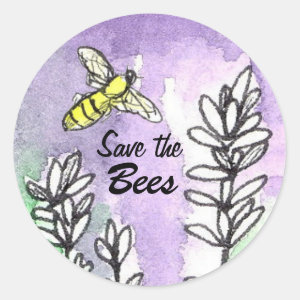 Save the Bees Lavender Flowers Watercolor Classic Round Sticker
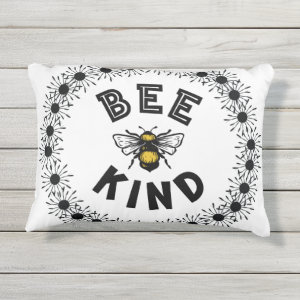 Bee Kind Bumble Bee Kindness Floral Design Outdoor Pillow
 Watercolor Bee Pattern Tissue Paper
 Thank You BA-BEE Baby Shower Yellow Polkadot Classic Round Sticker
 BEES and LadyBugs - Art by LeahG Save The Bees Button
 BUZZING For ARRIVAL of BA BEE Baby Shower Yellow Postcard
 Thank You BA-BEE Baby Shower Yellow Polkadot Paper Plate
 Thank You BA-BEE Baby Shower Yellow Polkadot Small Gift Bag
 BUZZING For ARRIVAL of BA BEE Baby Shower Yellow Magnetic Invitation
 BEES and LadyBugs - Art by LeahG Save The Bees Notebook
 Honey Bees Beek keepers Wedding Magnet
 Honey Bees Beek keepers Wedding
 BUZZY YEAR Monogram BEE Yellow Polkadots Student Notebook
 Watercolor Bee Pattern Yoga Mat
 Save the Bees Please Yellow Bumper Sticker I
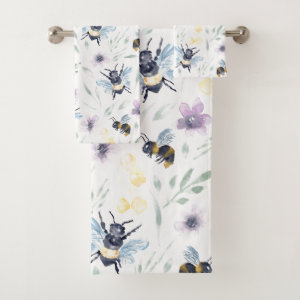 Watercolor Bee Pattern Bath Towel Set

 Posts
Posts


